Search Map It! Okinawa

Showing posts with label Ghost Stories. Show all posts

Thursday, October 30, 2014

The Legend of Nanga Bozu

A lonely road near Benoki Mountains


View Map It! Okinawa in a larger map
Benoki Dam

     GPS*
     LatitudeLongitude
     N 26 47.199E 128 15.339

     *GPS is to the Benoki Dam


The Long Road from a Demon's Past...

Every other year on the 16th of January, people from the town of Benoki come together and pay their respects to a fallen ancestor. Incense burning and prayers are part of the formalities to this melancholy, yet solemn occasion. It is their way of keeping the peace in Benoki; a reverent act to tame a demon with hopes that he never returns.

Some time at the beginning of the Meiji Period...
Angry voices reverberated through the forest trees. Soon the mob would reach him. Closer and closer, they narrowed in. The man knew his attackers were not far behind.

Fate had turned against him; For it was not too long ago, when he was the one doing the chasing and harassing. Now, the shaven-headed man found himself fleeing for his life... for the second time. Shortly before that, he had fled Shuri. Something there too had caused him to go into exile. When he escaped to Benoki, he sought refuge in the Nanga Forest, high up in the Benoki mountains. No one knew his real name. He was just a shaven-headed man from Nanga. The Nanga Bozu they called him.(ii)

But his welcome was a short one. Soon after he arrived, he took advantage of the town's meek and kind-spirited demeanor. He would often maraud through the village taking whatever he wanted, especially their livestock. Women and children were constantly harassed. No one knows why he did it. He was just a wicked man. Something very dark had swelled in his soul. Now, the villagers were forced into a dilemma. Evil had made its way to their home; and the once humble and good-hearted people of Benoki found themselves in a very precarious situation. They were going to do the unthinkable.

The chase had finally come to its end. The Nanga Bozu was trapped like a wild animal. Armed with sickles, the villagers cornered the unruly man. Time, as if capable of fatigue, had limped to a halt. All that could be heard now was whispering cries of the wind; and then suddenly, that too had quietly faded away. Fear had taken root; it seemed to be the only life force the villagers had left. One by one, they closed in on the shaven-headed man. There would be no turning back now.
History for the town of Benoki was about to change... forever.
January 16th, better known as Jyuu Ryoku Nichi, is no ordinary date. In the old calendar system(iii), this is New Years for the Dead in Okinawa. The townspeople of Benoki chose that particular day to pay homage to the Nanga Bozu, or whoever that man really was many years ago. It was their way to make peace with what had happened on that tragic day; for they were truly sorry that it ended with his death. Did he deserve to die? Was justice served? Lingering questions like these continue to haunt the Benoki people.

As time went on, rumors and ghost stories drifted about of what really happened on that day in the Nanga Forest. It was said that when they slayed him, his body had fallen near a creek and that his blood had filled the entire stream. Villagers have later claimed to see the creek turn into a pool of blood. "The Nanga Bozu is returning!", they believed. This creek later became known as Uninga. In the Okinawan language this means the demon's creek.(6)(i) It was also said that when the villagers attacked the shaven-headed man, he unleashed some kind of dark magic and sorcery against them. He or it was not from this world. "Could the Nanga Bozu really come back from the dead?", they thought. For fear that he would return, the villagers would offer a pig's head as a sacrifice to appease him. But that particular tradition had faded away over time, as well as the whereabouts of the Nanga Forest and Uninga. Their location and all memory of them... lost with time. Perhaps, it was meant to be.

For now, it would seem that the true demon is nothing more than a haunted past, for it was a tragic time indeed. Humanity had suffered a loss; a man had sold his soul into a world of darkness, and a once innocent town was now left to bear the guilt for the rest of time. Despite it all, hope still remains in Benoki. In a word, the 16th of January means reconciliation. Though it is a sad moment in their history, it is a way for the villagers to revisit and learn from the past and move forward towards a happier future. The road to peace may be long, but as villagers gather on that 16th Day, it is an occasion to face their demon head on, much like their ancestors did many, many years ago in the woods of the Nanga Forest.

The Origins of the Story. The Benoki Village Chronicles (dtd 20 January 1998) explains that the incident involving the Nanga Bozu was the reason why the villagers first embraced the 16th of January as a communal occasion. But the overall story is believed to have some basis in the truth; the Nanga Bozu man did exist and that he was later hunted down for his crimes. And as for the Nanga region, that too is thought to be somewhere high in the Benoki mountains. No one really knows for sure anymore. But a different version of the story may give clues to its location. The village chronicles states that the Nanga Bozu may have been killed by the people of Uka, the next village to the north. After they killed him, they discarded his body in Benoki. Author's speculation. If this is true, then it seems highly unlikely that anyone would carry a body great distances through the mountains. This would hint that maybe the Nanga region lies somewhere near the border of Uka and Benoki.

Additionally, the village chronicles never mentions anything about Uninga, the Demon Creek, or the use of demonic powers by the Nanga Bozu. It was only mentioned in Kunigami's Historical Chronicles, dtd 1967 (note: Benoki is a town within the Kunigami Village District). This same version was later retold in the Ryukyu Shimpo, March 17th 2013 edition. It appears it was just a ghost story version that took a life of its own. So it would seem.

The Man from Shuri. An intriguing question remains; Who was this Nanga Bozu? Did he have a name? Where did he really come from? Many believe he was indeed from Shuri. Villagers had observed that he could read and write, implying that he had a formal education. This would seem to make sense, especially for someone who had lived in Shuri. It would have been rare for a commoner to have such an education during that period. Some villagers today speculated that he even might have been a monk because of his apparent level of knowledge and shaven head.

There is one last clue. The Benoki chronicles infers that the Nanga Bozu story originated some time at the beginning of the Meiji Period (1868-1912) and that he fled Shuri because of a 'conflict' that had occurred there (based on the interpretation, the translation seems to hint that it was some kind of armed conflict). It makes no mention of exactly what that conflict was.

Author's observation and conjecture. The closest and perhaps the largest political upheaval involving Shuri was in 1879 (eleven years after the birth of the Meiji Period) when the last Ryukyu King, Sho Tai, surrendered Shuri Castle and the kingdom to the Meiji Government.(5) In 2012, the Ryukyu Shimpo featured an article covering a historical play that relives that transition of power.(4) The play was titled “The Surrender of Shuri Castle”. Interesting enough, the Ryukyu Shimpo writes, “The play tells the story of when the Meiji government ordered the abolishment of the Ryukyu han (feudal domain) and forced the surrender of Shuri Castle. A confrontation ensued between the pro-Japan party and the pro-China party.” Could this confrontation be the conflict the Nanga Bozu's story was referring to? And the reason why the mystery man went into exile? This is pure conjecture. There are no facts to support this theory.

Epilogue. Benoki is a quiet town, and just as quiet is the Benoki Dam further up the hill. At first glance this functioning dam seems deserted. Not many people come here. There is a certain emptiness about the place. And when you arrive at the dam, you'll find yourself immediately engulfed by the Benoki mountains. Somewhere in that vast abyss of forest greenery lies the Nanga Forest. And what of the Nanga Bozu? Today, there is no indication that people of Benoki believe in any such ghost. It is just a haunted memory. But a stroll around the perimeter is revealing. As you explore the back roads, one cannot help but to feel that you are being watched. And as you gaze into the whispering treeline, one cannot help but to wonder that somewhere within the forest shadows is a lost soul, a specter of the past, silently waiting his return.

Related Articles. Jyuu Roku Nichi - New Year's for the Dead.

Other Okinawan Ghost Stories. Haunted Ruins in Kyoda, Legend of the Okukubi River.

Other Places to Visit Nearby. The Benoki Utaki.

Reference.
1. Nanga Bozu, Benoki Village Chronicles, Book, dtd 20 January 1998 (Azashi Benoki January 20 Heisei 16), pgs 213 -214
2. Nanga Bozu (Ghost Story), Kunigami's Historical Chronicles, Book, dtd 1967, pg 78
3. Nanga Bozu (Ghost Story), Ryukyu Shimpo, Newspaper, dtd 17 March 2013
4. Historical Play - "The Surrending of Shuri Castle", online article, dtd 12 December 2013
5.  Sho Tai surrenders the  Ryukyu Kingdom - Resistant Islands: Okinawa Confronts Japan and the United States, book, McCormack, Norimatsu, Pub 16 July 2012, pg 4
6. Definition of uni - Okinawan-English Wordbook, book, Sakihara, University of Hawaii Press 2006, pg 195 .
7. Dates of the Meiji PeriodEncyclopedia Britannica, online reference

Notes.
i. Uni in the Okinawan dialect means demon. In Japanese this is pronounced as Oni. Ga is Okinawan (usually annexed as a suffix) is a term that means water or stream. The extra n in the middle of Uninga could be a variant of the Okinawan language of how it is pronounced. In the Benoki Chronicles it is spelled with an extra n.
ii. Bozu is a Japanese term often referring to someone or something that is bald.
iii. The Old Calendar (kyureki in Japanese) refers to the Lunar Calendar which is still observed in many parts of Okinawa, particular in rural areas. The New Calendar (shinreki) is the current Gregoria Calendar System. It is not uncommon to find calendars made in Okinawa that have both dates. Typically, spiritual occasions are observed on the Old Calendar System.

Directions. Take Highway 58 north into Kunigami Village. The turn-off will be at large Silo-like structure off of Highway 58 (See LandMark Icon on the map). The road will zig-zag up the hills. You will pass a large wooden Torii next to a small concrete fenced off building (See LandMark Icon on the map). Continue further up the hill until you run into the Benoki Dam.

Tuesday, October 29, 2013

Legend of the Okukubi River

Mangrove roots. Like a million headless bodies crawling along the river...


View Map It! Okinawa in a larger map
Legend of the Okukubi River

     GPS
     LatitudeLongitude
     N 26 27.391E 127 56.487


A River of a Hundred Million Necks?

One of Kin Town's most attractive natural habitats is the Okukubi River. It has become a sanctuary for wildlife and a playground for nature lovers. Everyday, thousands of vehicles drive over the Kin Bridge as the Okukubi River streams quietly underneath. What's most intriguing about the river is not so much its natural beauty, but the mystery behind its name. How did it get it?

Written in its kanji (億首川), the Okukubi River, could be interpreted as a River of a Hundred Million Necks; a somewhat gruesome description for such a benign place. Did something very dark happen here long ago?

As of yet, there is no official story to the name's origin, but there is one popular legend that has been documented in Kin. The story takes places at the time of the Satsuma invasion of the Ryukyus, some time between the 16th and 17th century. Could the legend unlock the secret to its name?

The story...
A long time ago, a samurai from Shuri had traveled to the village of Kin. During his travels he had met a peasant girl and fell in love. But marriage was unthinkable; for she was a simple peasant and he, a noble samurai. Shortly after, the samurai was called back to Shuri. Destiny would keep them apart.

But something was about to change forever. After he had left, the woman realized she was pregnant with his child. Nine months later, she gave birth to their son and named him,
Tetsu-o.

Years later, Tetsu-o would grow up to be a man of super-human strength. It was also about the same time that soldiers from the Satsuma domain were constantly harassing the villagers of Kin. Using his natural powers, he defended the village and killed many, many Satsuma invaders. To the Satsuma soldiers, Tetsu-o was a man forged out of iron, a man impossible to kill. They needed to find someone to defeat him, the one person that could crush Tetsu-o once and for all.

They didn't have to look far... they found a man named Kochi Oyakata, a man very familiar with Tetsu-o.

Kochi, at one time, was the martial arts instructor for the village,... until he was promptly replaced by Tetsu-o. Now, only deep-seated, hatred fueled Kochi's blood for this so-called “iron man”. Sure enough, the Satsuma soldiers had found the enemy of their enemy.

But to kill a man of iron, one question still lingered...what made a mere peasant boy so powerful against the will of many?

After his samurai father had left, Tetsu-o's mother became shameful of her pregnancy. Out of desperation, she continuously digested small pieces of iron to kill her unborn child, but to no avail. She eventually accepted her destiny; gave birth to a son, and named him Tetsu-o, a name which means 'Iron Boy'. It was the iron in his veins, the very element that was once used to poison him, that had ironically become the source of his strength.

Still, every man has a weakness. Tetsu-o, a man skin-clothed in metal, could only be cut in one place; the one place made of flesh and not iron,... his neck.
Kochi knew.

And on that fateful day, Tetsu-o's body lied their slumped, slayed like an animal. Kochi had gotten his revenge. He had stabbed Tetsu-o in the neck, killing him instantly,...leaving his body for all to see.

Now with Tetsu-o out of the way, the Satsuma soldiers were sure to wreak havoc once again. Chasing the villagers, they stormed up a large, steep hill. As the soldiers reached the apex they saw a haunting figure, a ghost from the past. It was Tetsu-o!..standing there tall and fierce! Frighten and full of despair, the Satsuma soldiers fell to their doom. A resurrected Tetsu-o had returned to destroy his enemies once and for all!
Epilogue. The villagers of Kin had out smarted their foe. After Tetsu-o's untimely death, the villagers knew the invaders would soon return. They took Tetsu-o's dead body and erected him on a hill, next to a river; the same river where Tetsu-o had slayed many, many Satsuma soldiers... and which happen to be the final location of his triumph.

Thereafter, that river became known as the Okukubi River... a River of a Hundred Million Necks; a name giving tribute to a hero, and a monument of the number of soldiers he had slayed.

Today. The story is not considered to be historical fact by the Kin Town Board of Education, it is however, officially recorded as a historical legend of Kin and is documented in their Book of Folklore and Legends publication (1989). The Kin Town Historical Office did offer one other possible explanation for the river's name. Okukubi could also be loosely translated as a river's neck. Oku, in this case, would mean something to the back or the interior, thus making it the neck at the a back of the river (or the neck upstream). However, the way the kanji is currently written, the Okukubi River (億首川) could only be interpreted as a “river of a hundred million necks”.

Is the River Considered Haunted? In the same folklore publication, a separate story was written (pg 80) where villagers claimed to see spirits along the Okububi River, but does not go any further in describing the incident or if it had anything to do with the Okukubi Legend. By my estimation, I do not sense that most people of Kin view the river as haunted. But they are somewhat familiar with the legend because of its name. There is even a recreational nature facility at the mouth of the river and a dam not far upstream. Farmers, construction workers, nature enthusiast, photographers,...all travel along the river every day. For now, the Okububi River seems to be in good standing.

For now.

Reference. Kin Town's Book of Folklore and Legends dtd 1989, (Okukubi Legend, pg 132).

Acknowledgment. Much appreciation is owed to the Kin Town Historical Office for their cooperation in bringing this story about. In particular, Ms. Nakama deserves much gratitude for her invaluable assistance and patience with the story's development.

Photo caption. The caption to the photo above is the author's own metaphoric comparison based on the legend. The comparison has not been heard, nor stated by any village resident during the research of this story.

Directons. Please view the map for the most direct route to the Okukubi River. If traveling north on Highway 329, take the first immediate left just before the Kin Bridge (designated by a pink thumbtack). You will travel down a hill and see the Kin Dam shortly after (it will be on your left). Near the bottom of the hill you will see an improved road that takes you east under the Kin Bridge and then towards the ocean. The Okukubi River will be on your right. You will have to travel on a dirt road if you wish to continue parallel with the river. The Balloon Icon in the map marks the last river bridge before you get to Nature Mirai-kan, Kin's nature recreational facility. There are are several observation decks and boardwalks along the river should you wish to get a closer look of the river.

Other Places of Interest Nearby. Joy and A Guinness World Record (Nature Mirai-kan).

Other Okinawan Ghost Stories. Haunted Ruins in Kyoda, The Legend of Nanga Bozu

Wednesday, October 24, 2012

"Ghost Stories: Haunted Ruins in Kyoda"

Entrance to Nago's famed Haunted Ruins


View Map It! Okinawa in a larger map
O-Files: Haunted Ruins, Kyoda

     GPS
     LatitudeLongitude
     N 26 32.462E 127 57.839


O-File Mystery: The Kyoda House

There is Okinawa and then,.... there is Okinawa. The former is one we have come to know and love. The latter is a place few talk about, but many have come to fear... a parallel world that lives in the subconscious of every Okinawan; a universe filled with the occult where wayward spirits dwell and thrive. It is a place neither here, nor on the other side. It is Okinawa's underworld.

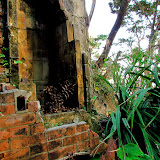
In Nago City, in the town of Kyoda there is a lonely trail right off Highway 58 that thousands of cars pass by everyday. It leads to an empty lot on beachfront property. It was said that a two story building of European-style design once stood here for many, many years (possibly since the 1970's or much longer). All that remains now are ruins of an old brick-style kitchen and remnants of an old room. Stories have surfaced claiming sightings of ghost and spirits in and around the area. With stories like these, separating fact from fiction is almost next to impossible particularly in the internet age where rumors run more rampant than ghost themselves. Here is a summary of one internet rumor,
People of foreign nationality (possibly Americans) once lived here (Kyoda) many years ago. There was a murder and subsequently, a ghost would be seen in the area described as a foreign male wearing blue jeans and a white shirt. It was also said that a Statue of the Virgin Mary was on the premises and if one saw it, they would become faint.
It shouldn't be any surprise that many people from the western part of Nago know about this place. You just have to ask around. Like all good ghost stories, they are often perpetuated by rumor and by the youth class. Residents of Nago that I spoke to (all from different areas with ages ranging from 17 to the their mid-thirties) have heard about the hauntings in Kyoda. But a much older Okinawan man who lived in Nago does not believe there was any kind of murder, just that strange things were reported to happen in that area. He said their was speculation that these strange occurrences happen because the house stood on the same grounds where a certain 'kami-sama' or god was once worshiped. The house just happened to be in the way.

Today. Internet rumors claim it was destroyed a few years ago. The cause said to be a fire. However, during a recent visit, no visible charred marks could be seen in the surrounding rubble or vegetation. Pictures of the actual building intact could not yet be found. However, there is a Three-Part YouTube Video by famed Japanese actor and storyteller, Junji Inagawa, where he is conducting a night visit of the Kyoda House some time before it was destroyed. The video is all in Japanese. See links below.

Epilogue. Somebody out there knows something. Somebody lived in that house at one time. For now, it seems that the story behind the Kyoda House will remain in the archives of the long and growing list of unsolved mysteries, in a special section under the letter 'O'. Regardless if the hauntings are real or not, what is real is that the people of Nago believe it to be real. 

Source Links.
http://ghostmap.sakura.ne.jp/spotdetail.php?spotcd=40
http://www.youtube.com/watch?v=A60pcLgvHy4&feature=player_embedded (Part 1)
http://www.youtube.com/watch?v=wuDOJpLEuWM&feature=relmfu (Part 2)
http://www.youtube.com/watch?v=bynXQEz2LZ8&feature=relmfu (Part 3)

Other Okinawan Ghost Stories. The Legend of the Okukubi RiverThe Legend of Nanga Bozu.

Directions. Access to the trail is right off of Highway 58, about 100 meters south of the Highway 71/58 Intersection. You can only access this trail going northbound on Highway 58. There is a small turn-off where you can pull in and park your car. This pull-off will be under the expressway. On one of the pillars near the turn-off the characters 'B-P7' can be seen in large print as seen in this photo. The entry way to the trail is right on the turn-off.

Other places of interest nearby: Kyoda's Two Giant Shisas, The Kyoda Utaki, Kyoda's Water from HandsTodoroki Waterfall, Nago Green Bridge/Lower Creek Park, The Nangusuku Castle Ruins, Nago Museum.